
Posted by Pack Ya Bags Travel on 5th Jun 2025
Why a Luxury Cruise Is the Best Way to Experience the Galapagos Islands
The Galapagos Islands are one of the few places on earth that genuinely exceed expectation. Travellers who have visited consistently describe it as transformative in a way that few destinations are — a place where wildlife encounters are so close and so unhurried that they shift how you think about the natural world. Charles Darwin reached similar conclusions when he arrived in 1835.
The reason the Galapagos delivers at this level — and the reason a luxury small ship cruise is the optimal way to experience it — is a combination of strict access controls, remarkable biodiversity, and the logistics of an archipelago spread across 45,000 square kilometres of protected ocean. Understanding these factors makes clear why the cruise format isn't just the most comfortable option. It's the best one.
Why You Can't Simply Arrive and Explore
The Galapagos Islands are a UNESCO World Heritage Site and one of the most carefully managed tourist destinations in the world. Ecuador's national park authority controls visitor numbers, access routes, and the activities permitted at each site. Independent travellers staying in land-based accommodation on the inhabited islands (Santa Cruz, San Cristobal, Isabela, and Floreana) have access to a limited range of visitor sites, most within reach of day boats.
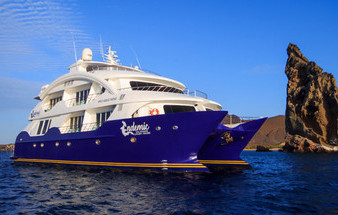
A live-aboard cruise — particularly a small ship with a licensed naturalist guide — operates under a different permit system that grants access to visitor sites across the archipelago, including remote islands and wildlife zones that are off-limits to day visitors. The uninhabited islands where wildlife is most abundant, most varied, and least habituated to human presence are predominantly accessible only via licensed cruise vessels.
This isn't a minor distinction. It's the difference between seeing the Galapagos from its edges and experiencing it from its centre.
The Wildlife — and Why the Small Ship Format Matters
The Galapagos' defining characteristic is wildlife that has evolved with virtually no natural predators and no inherited fear of humans. Marine iguanas bask centimetres from your feet. Sea lions sleep on paths and ignore you. Blue-footed boobies perform their courtship dances without interrupting themselves for your camera. Galapagos penguins swim alongside snorkellers. Giant tortoises move through their territory with complete indifference to observers.
This intimacy is only preserved through careful management of visitor numbers per site. The national park rules cap the number of people at each landing at any one time — typically no more than 16 to 20 visitors accompanied by a licensed naturalist guide. A large ship carrying 300 or 400 passengers rotates groups through the same sites in shifts; a small ship with 40 to 100 passengers visits sites as a cohesive group with a single guide, on a flexible timetable.
The small ship format means that when a snorkelling session with a school of hammerhead sharks presents itself, or when a waved albatross begins a landing display at Española Island, the itinerary bends to accommodate it. A large ship rotation cannot do this.
What a Typical Day Looks Like
Days aboard a Galapagos luxury cruise follow a pattern shaped by the park authority's rules, the ship's itinerary, and what the wildlife is doing. A typical day involves two to three excursions — a morning landing, an afternoon snorkel, perhaps an evening panga (small boat) ride along a coastline — interspersed with time aboard the vessel for meals, presentations from the onboard naturalist, and transit to the next island.
The naturalist presentations are worth highlighting specifically. On a quality luxury cruise, the onboard guide is not a tour operator employee running a script. They are typically a trained Ecuadorian scientist or natural historian with deep specialist knowledge of the archipelago — its geology, evolutionary biology, conservation history, and individual species. These evening sessions genuinely deepen what you see during the day, and they're one of the things guests most consistently mention in retrospect as unexpectedly valuable.
The Luxury Component: Why It Matters Here
In many destinations, the choice between a mid-range and a luxury cruise is primarily a comfort decision. In the Galapagos, the luxury component has additional operational implications.
Premium operators — those working with vessels like the Isabela II, the Grace, or Silversea's Silver Origin — operate under the most coveted national park permits, which grant access to the broadest range of visitor sites. They invest in maintaining the highest guide certification levels. They carry specialist equipment — underwater cameras, kayaks, glass-bottom boats — that mid-range operators don't. And they maintain small passenger numbers not because regulations require it, but because the experience demands it.
This means that choosing a luxury Galapagos cruise isn't simply paying more for a nicer cabin. You're accessing better sites, better guidance, and a better managed experience.
Planning a Galapagos Cruise from Australia
The Galapagos Islands are reached via Quito or Guayaquil in Ecuador, typically with a connection through Los Angeles, Miami, or a Latin American hub. From Australia, the journey is substantial — usually 24 to 30 hours each way — which means the vast majority of Australians who visit the Galapagos combine it with time in Ecuador, Peru, or elsewhere in South America.
Cruise departures are year-round, and the Galapagos is genuinely good at any time — the wildlife calendar varies by species rather than switching off in an off-season. The northern islands tend to be calmer from June to December; the southern islands, including the prime whale shark and hammerhead sites, are at their best from January to May.
The most important planning decision is vessel selection. The difference in experience between a well-run luxury small ship and a poorly managed mid-range vessel is considerable, and it's not always apparent from websites or price lists. A specialist who knows the operators firsthand is the most reliable way to get this right.
Pack Ya Bags has experience arranging Galapagos cruises for Australian travellers, including combined Ecuador and South America itineraries. Talk to our team about which vessels and departure dates best suit what you're planning.
Written by Pack Ya Bags Travel Team
Specialists in curated adventure travel since 1974