
Posted by Pack Ya Bags Travel on 1st Sep 2026
The Colours of Japan: What Koyo Season Is Really Like on Tour
Cherry blossom gets the headlines; koyo gets the connoisseurs. Japan’s autumn colour season runs from late September into early December, moving gradually from Hokkaido and the high mountains down to the cities of central and southern Japan. November brings some of the country’s most comfortable sightseeing weather, and the combination of maples, temple gardens and mountain scenery is the reason most autumn itineraries are built the way they are. The trick is not picking the right week for Japan — it is building the itinerary so the colour comes to you.
How the colour moves
Autumn broadly reverses the direction of spring. Colour begins in the far north and at high altitude, generally from late September in Hokkaido, works through the Alps and Nikko in October and into early November, and reaches Kyoto and Tokyo from the middle of November, with some areas holding into early December. Altitude matters as much as latitude: a mountain can be past peak while the town at the bottom of the same road has barely turned. A well-built koyo itinerary follows that front — mountains first, cities last — so the trip meets peak colour more than once rather than betting everything on one date. It is the same logic as chasing the blossom front, run in reverse (our when-to-go guide maps both seasons).
The scenes worth building a trip around
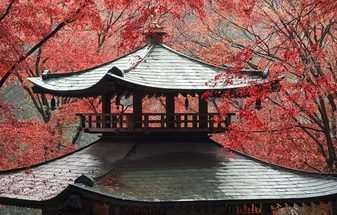
Kyoto from the middle of November is the best known: Tofukuji’s valley of maples, the Arashiyama hillsides, and temple gardens whose composition makes extraordinary use of autumn colour — plus evening illuminations, when a number of temples reopen after dark during the foliage season. Nikko pairs shrines with gorges of colour through October and into early November. Hakone and the Alps give you maples with mountain and lake backdrops. Miyajima and the Inland Sea add a sea-and-shrine contrast. Kyoto in particular is busiest at peak foliage, so early starts and weekdays make a noticeable difference.
What a koyo day feels like on tour
Cool, crisp and generally comfortable for walking, though temperatures vary sharply by region and elevation — Kyoto and Tokyo can be mild through November, while Hokkaido and the mountain areas are considerably colder, and mornings and evenings are colder again than the middle of the day. A typical day: the famous gardens early, before the coaches; a lunch that has changed over to autumn ingredients such as matsutake, chestnut and persimmon; an afternoon ryokan check-in; and an onsen while the maples redden outside the bath. Autumn is one of Japan’s great seasonal food periods, and it shows on the menu everywhere from a kaiseki counter to a station bento.
The booking picture
Kyoto in the second half of November is one of the most sought-after periods of the Japanese year, and the city itself reports November as its busiest month for visitors. Small ryokans, boutique hotels and the better guides carry the longest lead times of anything in the itinerary, so several months is sensible rather than optimistic. For late-November Kyoto we would be settling accommodation well before autumn rather than waiting on the foliage forecast — and there is a useful tension in that, because the forecast only becomes reliable relatively close to travel. In other words, the accommodation decision and the colour forecast do not arrive in the same order you would like them to. Booking later is possible; the compromise is usually the Kyoto nights, which is the part of the trip least worth compromising.
Your questions answered
When exactly is peak koyo?
There is no single Japan-wide peak. Hokkaido and the high mountain areas can turn from late September into October; Nikko and the Alps generally follow through October into early November; Kyoto and Tokyo are generally at their best from mid-November into early December, depending on the year and the location. The exact timing shifts with autumn temperatures and can move by around a week either way, so building an itinerary across several regions and elevations is a more reliable strategy than betting on one date.
When is the autumn foliage forecast published?
The Japanese forecasters generally publish a first national outlook in September and update it several times as autumn approaches. It is useful for fine-tuning a trip, but the early forecasts are necessarily less precise than the later ones — and by the time they firm up, many travellers have already committed to accommodation for the peak weeks. That is why the itinerary is usually built on the regional pattern and then tuned with the forecast, rather than the other way round.
Is autumn busier than cherry blossom?
Cherry blossom remains the bigger national phenomenon, but peak koyo in Kyoto can be extremely busy, particularly in the second half of November. The difference is that the koyo window is longer and spread across more of the country, so an itinerary has more room to move.
Is koyo season good for first-time visitors?
It suits a first trip well: the classic route works, the food is at its seasonal best, the sightseeing weather is comfortable, and you do not have to build the entire trip around a one-city blossom window.
See our Asia collection or ask the Pack Ya Bags team about November 2026 space and 2027 planning.